SEPTEMBER 26, 2025 NEWSLETTER
The THINC Foundation is dedicated to Transparency, Honesty, and Integrity in the Classroom.
Welcome to THINC Foundation’s newsletter! Releasing semi-monthly, it contains our views on key developments in Liberated Ethnic Studies (LES) in K-12 schools as well as relevant news articles and timely calls to action.

Despite Teachers’ Union Opposition, California Takes an Important Step Against Antisemitism
By Mitch Siegler, Founder
California legislators voted overwhelmingly in favor of AB 715, which addresses antisemitism in the state’s K-12 schools (35-0 in the California Senate, with 5 abstentions, and 71-0 in the Assembly, with 9 abstentions). Now, the bill heads to Governor Gavin Newsom’s desk for signature.
Governor Newsom understands the problem of antisemitism in California schools. Last year, he released the “Golden State Plan to Counter Antisemitism,” whose first paragraph reads, “Antisemitism has proliferated at a shocking speed in recent years, globally and here in California. Jewish people make up about 3% of California’s population, but anti-Jewish hate crimes accounted for 62.4% of all reported hate crimes involving religious bias in the state in 2022… And violence and threats have escalated since the terrorist attacks in Israel on October 7th.”
Should Gavin Newsom sign AB 715 into law, California would be the first state with an Antisemitism Prevention Coordinator, whose job it would be to “among other things, develop, consult, and provide antisemitism education to school personnel to identify and proactively prevent antisemitism and to make recommendations.”
AB 715 isn’t perfect. Several crucial examples of antisemitism were deleted from the draft, including “[l]anguage or images directly or indirectly denying the right of Israel to exist, demonizing Jewish people, or saying that Jewish people do not belong in a country or community.” The definition of “antisemitic learning environment” was removed. There are limited consequences and enforcement mechanisms – and with some 1,000 public school districts in California – compliance and follow-through will likely be onerous.
But we can’t make the perfect the enemy of the good. AB 715 decries the “vilification of Jews and Israelis” and states that the U.S. National Strategy to Counter Antisemitism, published by the Biden Administration in 2023, “shall be a basis to inform schools on how to identify, respond to, prevent, and counter antisemitism.” All of this is worth applauding.
Notably, several legislative diversity caucuses, including the Black, Latino, and Asian American and Pacific Islander, support AB 715.
But, and this can’t be emphasized enough, the 310,000-member California Teachers Association opposes it – and stridently. Predictably, so do radical organizations like the Democratic Socialists of America and anti-Zionist organizations like CAIR, CODEPINK, and the Coalition for Liberated Ethnic Studies. Their specious argument is that AB 715’s purpose isn’t to protect Jewish students, but to censor how teachers can talk about the Israeli-Palestinian conflict.
Even before the October 7, 2023, attacks on Israel, teachers were creating unsafe environments for Jewish students by singling out Israel for opprobrium. The situation has worsened considerably since then. If teachers are unable to broach the Israeli-Palestinian conflict without vilifying Israel, that’s a serious problem.
Unfortunately, it seems that is where we are. Something had to be done. And the passage of AB 715 in both houses of the California legislature is a major blow to radical activists.
Even if AB 715 is imperfect, California has taken the right step toward protecting Jewish students – and all students – from politicized agendas that do not belong anywhere near K-12 classrooms. Governor Newsom should sign it and set an example for the rest of the country.
On Disagreeing Agreeably
The shocking and appalling assassination of Charlie Kirk at Utah Valley University this month was the starkest of reminders that our country must realign behind common values.
Freedom of speech, enshrined nobly in the First Amendment of our Constitution, is among the bedrock principles of the United States. Speech is not violence, nor is violence ever the appropriate response to speech.
Yet as American civics education has degraded, so has commitment to civic principles. A full one-third of college students now believe that it’s acceptable to use violence to stop another’s speech – and that figure is rising.
Believing that those who hold opposing views are not opponents but enemies leads to dehumanization and, as we have seen, murder.
We need civics to teach children not just how to disagree agreeably, but why they must. A democratic republic is impossible if too many people believe that violence, not reasoned debate, is the appropriate way to address important issues.
When students appreciate each individual as an individual, not just as a member of a monolithic ethnic group or political party, they are equipped to engage with their ideas without dismissal or hostility. Only through that appreciation can we return to a sensible public discourse free of political violence.
Advisory Council Spotlight: Maya Phillips
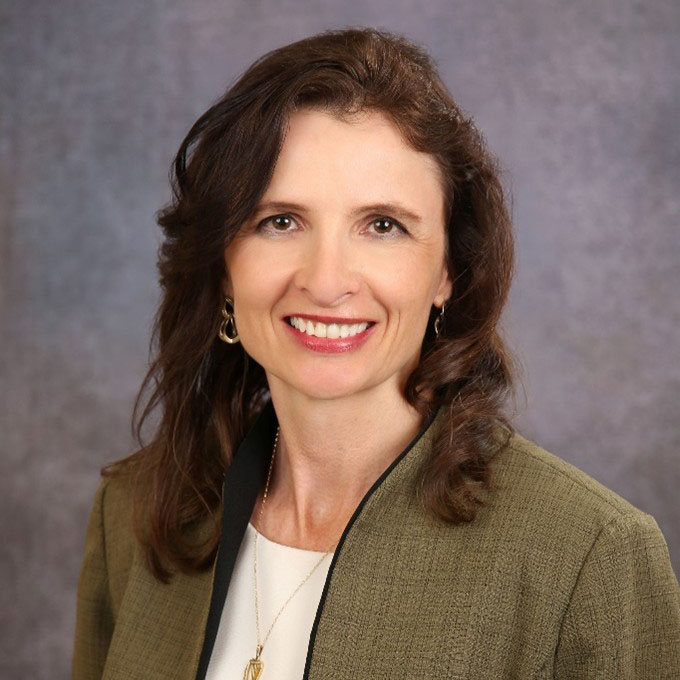
Maya Phillips grew up in Saint Petersburg, Russia in the former Soviet Union. Maya immigrated to the U.S. in 1999 and became an American citizen in 2006. She works in translation and property management.
Maya serves on the Ramona (California) Unified School District Board of Trustees. She was appointed to a vacant board seat in March 2022 and elected for a full term in November 2022, with her current term running through 2026. The Ramona USD Board of Trustees voted against establishing a mandated ethnic studies course requirement in 2025.
Maya is a strong advocate for academics, local control, and parental rights. She has written extensively about the parallels between Liberated Ethnic Studies in K-12 education and political ideology in education she experienced in the former Soviet Union.
Thanks for your great work, Maya!
THINC Voices
We wanted to share the two most recent installments of our THINC Voices video series.
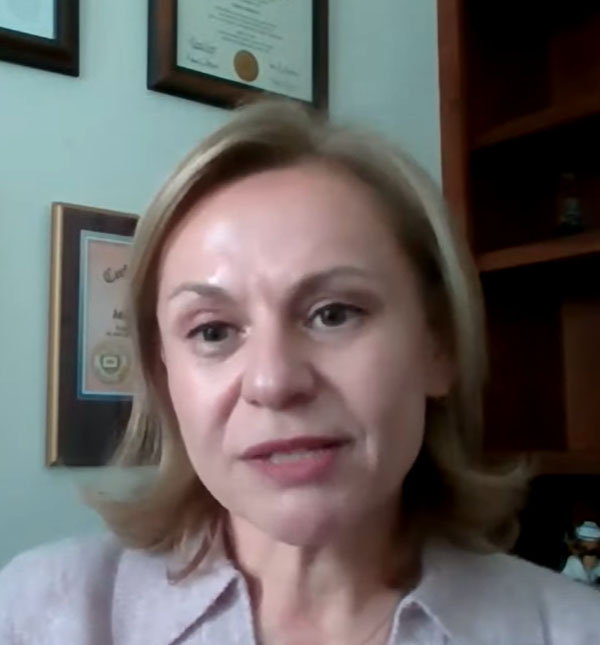
Neurologist Dr. Diana Blum discusses how remote learning during COVID opened her eyes to radicalism in K-12 education – and how schools tried to dodge accountability.
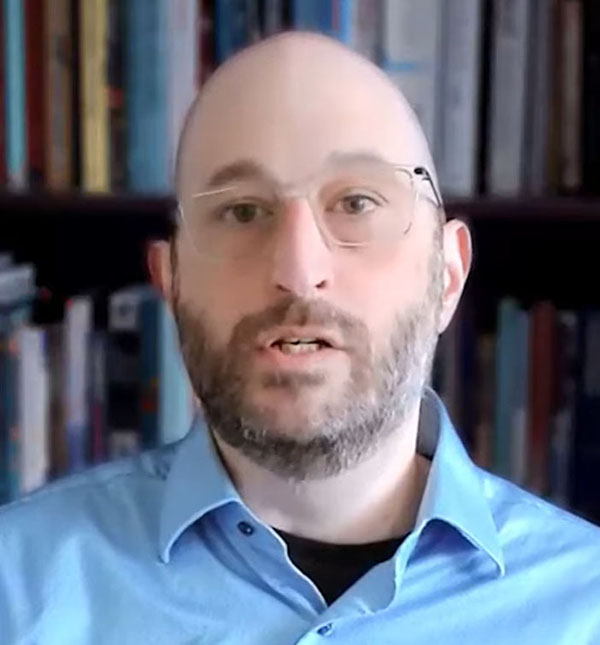
David Smokler, a former teacher and Executive Director of the K-12 Fairness Center at Stand With Us, discusses how LES takes a rigid, zero-sum approach, asserting that lifting up vulnerable minorities requires tearing “privileged” people – including Jews – down.
Liberated Ethnic Studies (LES) Activists in Their Own Words
We talk a lot about the LES movement’s extreme positions, but what does that look like in practice? Take a look at these quotes from prominent LES leaders.
“By anchoring an Antisemitism Prevention Coordinator in the highly contested International Holocaust Remembrance Alliance (IHRA) definition – a definition criticized for being used to silence political speech – this bill risks criminalizing or chilling discussion of Palestinian history and the humanitarian crisis in Gaza.”
- From an anti-AB 715 letter from a coalition of California Muslim organizations to Governor Newsom. In fact, the IHRA definition has been codified by more than 40 countries, including the United States, and is by far the most widely accepted definition of antisemitism. By attacking IHRA, the letter’s authors are admitting that they feel they cannot discuss Gaza without being antisemitic.
“Every single day the Zionist state gives us thousands of reasons for its immediate & complete destruction – the only future we ALL have requires its full dismantling & the eradication of Zionism.”
“The Zionist entity has *always* been an irredeemable genocidal project. If you are still defending it (in any capacity) you are an irredeemable genocide supporter.”
“Israel has a right to exist in the same way smallpox and the Black Death had a right to exist”
- Retweeted by Sean Malloy, Professor of History/Critical Race & Ethnic Studies at UC Merced
THINC in the News
“Oklahoma’s ‘America First’ Teacher Screening Test Spotlights Partisanship Debate,” Aaron Gifford, Epoch Times
“Jewish groups, parents worry about San Francisco district’s new ethnic-studies program,” Aaron Bandler, JNS
Support our Work
Our continued work depends on the generosity of people like you! Please consider making a contribution to THINC to fund our continued work to combat Liberated Ethnic Studies and advocate for more constructive education in K-12 schools.
THINC Foundation is a 501(c)(3) non-profit organization that is qualified to receive tax-deductible donations.